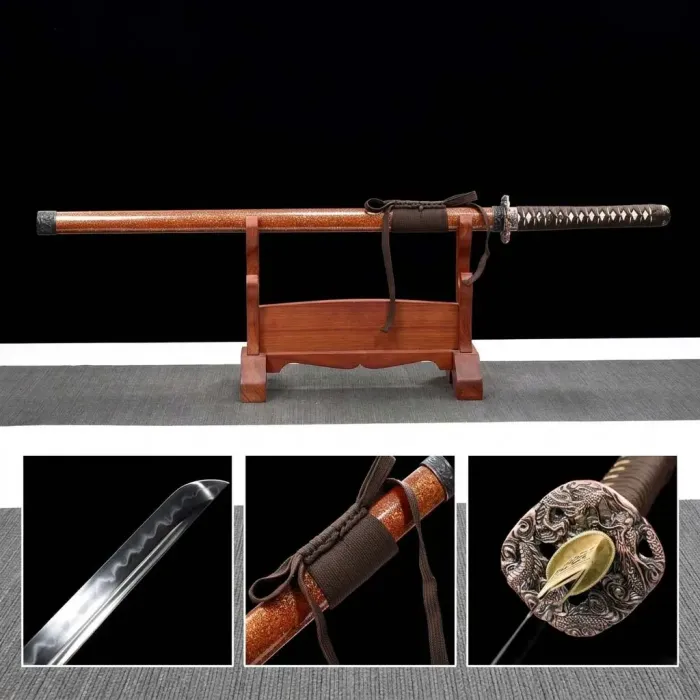
Every traditional Japanese sword is a magnificent example of fabrication, but imagine you desire to exhibit your separate aesthetic? Altering your sword is a deep journey, allowing you to build a truly unique piece. From the hold wrapping and fitting to the plate design and edge design, each segment offers a chance for distinctive style. This review delves into the space of katana transformations, providing details for both beginners and proficient enthusiasts hoping to imprint their stamp on the historic art of the samurai.
Novice's Certified Mastery
For those prepared to embark on the advantageous journey of classical sword techniques , 1060 steel katanas furnish an excellent entry point. This specific grade of structural steel hits a nice compromise between cost and functionality . While less than hard as upper-echelon steels, 1060 permits a workable level of honing , making it appropriate for beginners to learn the groundwork of blade preservation and understand the allure of handcrafted Japanese weaponry. It’s a fantastic choice for obtaining experience without the monetary burden of more sophisticated steels.
Grade T10 Cutting Tools : Finding Excellence and Economy
For fans seeking an authentic sword experience without overpowering the wallet , T10 metal katanas represent a advantageous option. These blades offer a clear improvement in endurance compared to inferior alternatives, exhibiting good edge retention and ample flexibility for rudimentary slicing techniques. While not rivaling the outstanding characteristics of ultimate steels like T100 or folded steel , T10 provides a worthwhile blend of efficiency and budget-friendly nature , making them a popular choice for students and those on a fixed revenue .
Going past the Blade : Personalizing Your Sword's Adornments and Handle
Despite the buffed cutting surface is undeniably the core point of a katana, truly heightening its grandeur lies in the cautious customization of its components and haft . This method allows users to demonstrate their personal character. Weigh the extensive possibilities: menuki - decorative charms that contribute visual attraction ; the hamon sleeves – often artistically fashioned ; the tsuka center itself, wrapped in conventional ito lace ; and the fusa stopper , which can be fashioned from various substances like treasures or antler .
- Adopt concepts that echo with you.
- Test with different ingredients .
- Prioritize superiority for a lasting effect .
The Allure of the Katana: History, Craftsmanship, and Steel
An oriental cutlery features a matchless allure, steeped in ages of the nation's history and culture . More than merely a device of hostilities , it's a sign of the fighter class ethos – a fusion of prowess and discipline . Its development spanned several generations, with early swords evolving into the elegant curvature and deadly edge we recognize today. The craftsmanship involved is truly spectacular, requiring epochs of preparation to achieve . The process involves a elaborate folding of wrought steel , creating layers that reinforce the cutting edge’s flexibility and severing ability. Different schools of manufacturing started , each with their individual secrets and techniques for achieving the optimal poise and sharpness - a truly challenging pursuit.
- Primary Katana forms
- The responsibility of the nihonto in soldier culture
- Old-fashioned smithing styles
Selecting the Suitable Steel for Your Japanese Sword Project: 1060 vs. T10
Electing the right steel is fundamentally important for any katana project, and the determination between 1060 and T10 can be delicate. 1060 is a common American material, offering a solid balance of strength and sturdiness, supplying it relatively easy to process. However, T10, a Oriental steel, commonly boasts better wear durability and can likely achieve a elevated terminal hardness, although it can be somewhat troublesome to manage and requires meticulous heat forging. Consider your qualification and aimed outcomes: for a beginner, 1060 may be a more starting point, while the experienced smith might appreciate the additional properties of T10.
- Ease of Working
- Surface
- Ultimate Toughness
Revealing the Strength: Expert Katana Improvement Strategies
Refining the technique of katana adjustment extends far beyond basic sharpening. Serious dedicated users are now studying advanced techniques to truly liberate a blade's hidden potential. This incorporates intricate work with the blade border, utilizing specialized compounds for differential annealing and carefully identifying the profile of the shield to optimize balance and effectiveness. Beyond purely functional enhancements, artisans are increasingly focused on attaining unparalleled aesthetic splendor, through complex incising and layered polishes that truly transform a katana into a masterpiece.
From Elemental Metal to Artistry: Forging a 1060 Blade
The journey initiates with ordinary 1060 alloy , a strong material far from the beautiful katana it will shift into . Talented bladesmiths utilize a complicated process of stacking and constructing the crude steel, repeatedly raising it and striking it to rid impurities and build a stable grain structure. This tedious T10 steel katana process, often enduring for weeks , builds the essential toughness and elasticity characteristic of a real Japanese weapon . Subsequent heat methods , including controlled hardening and quenching , are vital to achieve the desired balance of sharpness, stability and loveliness .- Combining: Minimizes impurities and builds grain structure.
- Constructing: Creates the steel into the initial blade form.
- Conditioning: Defines the final hardness and flexibility.
The Durable Charm of the Katana: Intensive Inspection of Steel and Adaptation
Such iconic katana survives a potent symbol of Japanese civilization , its appeal far overtopping mere combat tools . Forged from rare steel and frequently featuring intricate ornaments , the method of creation itself is a esteemed art. Beyond the basic craftsmanship, the ability to adapt a katana - from the hamon to the handle wrapping and fitting - allows for a deeply individual communication for both collectors and wielders alike. This mixture of classical steelwork and boundless personalization leads the katana's continued renown across the terra .